Table of Contents - A handy way to check out my articles by topic
My most recent Guides:
As an Amazon Associate I earn from qualifying purchases.
You can reach me at: powerscorerpg@gmail.com

Friday, May 15, 2015

Dungeons and Dragons - A Guide to the Displacer Beast


The displacer beast is an iconic Dungeons & Dragons monster that sometimes seems like it is forgotten. I don't think I've ever seen an adventure where the displacer beast is in a major encounter. That strikes me as something of a travesty. While they are often included in a scenario, it is usually as a fight along the journey rather than the feature of a set-piece encounter.

I am going to run down the displacer beast lore from each edition to try to give a clear picture of all the relevant information available to us. I will also do my best to dig up displacer beast appearances in other official D&D publications.

In addition I will detail the cloak of displacement, made from the hide of a displacer beast, and we'll look at the hatred that exists between blink dogs and displacer beasts. How that story has evolved is really cool.

The point of this is to give you a good idea on how to run a displacer beast in your game. This guide should give you a nice outline and references to draw from.

Real Life Origins

Displacer Beasts are based on the Coeurl, a monster featured in novels by A.E. van Vogt. I don't completely understand what it did - the Coeurl feeds on people's "id." Not Freud's "Id", but organic phosphorus. The Coeurl can also manipulate "electric vibrations". Basically, it befriended crew of a spaceship and then started killing them.

There's a lot more detail here.

AD&D 1st Edition

The displacer beast is a "vaguely puma-like creature" with tentacles that are "dead black". The "molecular vibrations of the displacer beast are such that it always appears to be three feet [from] its actual position." Because of this they get a bonus to AC and saves.

It uses its two tentacles in combat, slashing victims with "the rough, horny edges of these appendages".

They hate all life - especially blink dogs. That's a weird little factoid. There's actually art of a pack of blink dogs devouring a displacer beast corpse.

I guess they hate each other because they are dogs and cats? If you check out the blink dog entry, you see that blink dogs can teleport at will, usually appearing behind an opponent.

"There is a great enmity between blink dogs and displacer beasts and the two creatures will always attack each other".

Dragon Magazine #109 - Ecology of the Displacer Beast

This article is written as if it came from the notes of a mage named Jen-Ahb who was later mauled to death by a displacer beast in the "University of Sarkawan". Things we learn:
  • It has six legs and a pair of horned tentacles.
  • It can appear to be up to a yard away from its actual position, an effect caused by "subtle vibrations emitted from its flesh that apparently refract light".
  • Cubs only have nubs, no tentacles.
  • They reach full maturity in four months.
  • Displacer beasts can see through each others displacement.
  • They can jump 20 feet straight up, and up to 50 feet across.
The article explains why displacer beasts and blink dogs hate each other. "The very actions of displacement and blinking seem to interfere with the nervous and mental systems of the opposing creatures." They can detect each other automatically because they sense the displacement or blinking up to 150 feet away.

There's even a pile of fun notes at the end, including:
  • The DM can roll a d10 to determine where a displacer beast's actual location is.
  • Most displacer beasts are neutral, but some are just plain evil.
  • Blink dogs will attack anyone wearing a cloak of displacement with great ferocity.
  • Displacement can not be dispelled like an illusion.
What a great article. It flowed well and was full of information.

Vault of the Drow

In this well-regarded adventure, the heroes explore the underdark and a drow city. The drow nobles have trained displacer beasts as pets. The drow like to form hunting parties to track and kill escaped slaves. These hunting parties include bugbears and trained displacer beasts.

AD&D 2nd Edition

The Monstrous Compendium entry includes piles of stuff from the ecology article. "Their eyes glow bright green, even after death". They hate all life, but never fight among themselves.

A second theory is offered as to why blink dogs and displacer beasts hate each other. Blink dogs are lawful good, and thus they hate the savage and destructive displacer beasts.

"The eyes of a displacer beast are a highly prized, if uncommon, good luck charm among thieves..."

Dungeon Magazine #36 - Asflag's Unintentional Emporium

This adventure is by Willie Walsh, a guy who wrote a ton of whimsical adventures for the magazine in around 1991. This adventure is about a wizard's tower in a city. The wizard, Asflag, was up to all sorts of experimental shenanigans and he kept all sorts of weird stuff in his tower. Asflag tried to summon a creature from another plane but ended up being carried away by the monster. All of the weird items and creatures that Asflag had collected now have run of the tower.

Asflag's displacer beasts are heading into the city at night hunting people and animals, and dragging their kills back to the tower to eat. People in the city are afraid to walk the streets at night. Obviously our heroes need to take care of this.

There's a nice review of this adventure here.

D&D 3rd Edition

They are described as skinny - "...nothing but muscle and bone." It is said that they eat small game and, get this, they can speak common!

Their displacement ability now causes the attacker to have a 50% chance of missing unless the attacker has truesight.

There's a new type of displacer beast - a pack lord. It's a mutant offspring that can grow up to 10 feet high and 20 feet long! Crazy.

Dungeon Magazine #119 - Wrath of the Abyss

Shahg and a displacer beast
This is the final part of a trilogy of drow-themed adventures. It's a complicated story involving the corruption of a city. The adventure actually includes Belgos and Silussa, famous villains from Gary Gygax's Vault of the Drow.

In this, the drow have trained displacer beasts that fight alongside them..

On the cover is Shahng, a female drow who has a "unique fighting style". She drinks a potion of haste and does a dervish dance, slicing into groups of heroes.

D&D 4th Edition

Displacer beasts are now natives of the Feywild. They also "...reside in the tangled forests and dark caverns of the natural world."

Displacement still causes attackers to miss 50% of the time. This effect stops and starts when it is hit and when it moves. This is one of the very few monsters in 4e that have threatening reach (seriously.. I can only think of about 3 creatures that had it).

We get very little lore. Here it is: "Displacer beasts can be trained as attack beasts or guard animals, but they're prone to turning against their trainers."

Monster Vault gives us a bit more info. Displacer beasts have lairs in foliage or up in trees. They take down the weakest targets first. Pack lords are as smart as ordinary people (!).

It is also stated that they are kept as status symbols by "callow young eladrin nobles."

The updated Monster Vault displacer beast handles displacement differently. Now, if a PC rolled an odd number on their attack roll, it misses. An even one hits it. The beast loses this trait until the start of its next turn.

Madness at Gardmore Abbey

This image is explained in the 5e section.
This is a big boxed-set adventure that deals with the deck of many things. The heroes explore the abbey that has been ravaged by the deck and is over-run by monsters.

In one section, the adventurers need to rescue an eladrin's sister. She's being attacked by some stirges and displacer beasts. There's some good flavor text:

"A pale, slender figure with long silver hair flees through the dark grove, her desperate footfalls making hardly a whisper. Behind her and to either side, two feline monsters pursue her in eerie silence toward a ruined bell tower. Their black, six-legged forms are hard to focus on clearly.

Spiny tentacles whip forward from the back of one of the beasts and lash the fleeing figure, who drops with an agonized shriek. A rustling at the top of the tower signals a nest of stirges, awakened to the scent of blood. On the ground, the tentacled beasts move in for the kill.
"

There's even flavor for if the heroes fail to save her: "The corpse of the young eladrin lies still and bone-pale among the roots and climbers of the grove. A star-shaped ring on her finger flares once and then falls dull as plain steel, as though a bright spirit had departed."

D&D 5th Edition

I am interested to see what we have here in the 5e monster manual.

They can't speak common. Their feywild origin has been expanded. Long ago, they were captured and trained by the Unseelie Court, and are used to hunt unicorns..! And pegasi..!! Wow. But the displacer beasts escaped their masters.

The fey hunters tried to track them down with blink dog companions at their side. Wow... awesome. Displacer beasts hunt for food and for sport. They'll toy with their prey.

Their displacement is now tied to the disadvantage mechanic. You have disadvantage until you hit them, then the effect is disrupted until the end of their next turn.

Last but not least, let's check out the cloak..

Cloak of Displacement

In 5th edition, when you wear this cloak it gives you the displacement effect. The displacement works just like it does on a displacer beast. People have disadvantage to hit you! Once hit, it's disrupted until the end of your next turn.

I really like that they made art of the cloak, and went out of their way to show that it is made of the hide of a displacer beast.

I wonder if anyone has a blink dog vest that lets them teleport? I think someone needs to make an adventure based on the conflict between displacer beasts and blink dogs.

Thanks for reading.

Wednesday, May 13, 2015

Princes of the Apocalypse - Sacred Stone Monastery

The game store now has five full tables running Princes of the Apocalypse. D&D 5e continues to grow here in New York.

I lost a player this week - the wild sorcerer. It's too bad, as he was a lot of fun. I remain concerned that I may lose more players.

I decided to use the elemental evil trinkets in this campaign. I decided to spice them up further, giving them special spell effects using spells from the back of the book.  The trinkets:
  • Transparent Gem: Sunnis, Archomental of Good, whispers to the wielder through the gem and gives advice.
  • Chisel with an Unfamiliar Symbol: Once per day, you can strike the ground with this and cast earth tremor.
  • Eyepatch made of Obsidian: Allows you to cast catapult once per day.
I had considered having the players come up with what the trinkets do, but that's a slippery slope. I asked them what they thought the owlbear ragdoll would do, and they came up with this: It's a bag of holding, and inside is a tiny demiplane where an owlbear lives. It will only hand them their stuff if they give it a snack.

Pretty awesome idea, I thought.

The Party
  • Elf Rogue: Played by a 4th grader, her character's name is Lucky and she has a black cat named "Bad Luck". 
  • Dwarf Cleric: In real life, played by Lucky's dad. He has a scottish accent and worships Ilmater.
  • Drow Rogue: Middle Schooler. Wants to be evil, but Adventurer's League rules restrict this. Has a dog.
  • Goliath Barbarian: Middle Schooler. Really nice guy.
  • Human Bard: The player is about 25 years old, knows the rules pretty well. 
  • Human Paladin: Worships Helm. Played by the bard's dad, who played old D&D and is new to 5e.
  • Human Rogue: A new player. Taking to the game very well.
The Galeb Duhr

Behold! Sedimentarious!
Our heroes had rested at Summit Hall and learned that the earth cult was lurking at the sacred stone monastery. They headed out to take it down.

Upon arriving, the heroes saw that the monastery had been under attack. The fire cult had just unsuccessfully tried to break in and steal a delegate - Bruldenthar the dwarf.

As the adventurers got close, they spotted a wounded fire cultist recoiling in fear from a giant boulder-man. He was a galeb duhr. I added this stuff in to explain the trinkets.

The galeb duhr was named Sedimentarious (I know, it's stupid). He was an agent of Sunnis, the Princess of Good Stone, archenemy of Ogremoch and his earth cult. Sedimentarious had come to the monastery to spy on the cult and thwart their evil schemes. He'd stashed trinkets in the place that would both harm the cultists and aid the heroes.

The heroes killed the cultist and made friends with Sedimentarious. He gave them a special trinket - a wooden box with red clay. The red clay was a symbiote (like Venom from spider-man). It bonded with Squirrel Man and gave him clay armor that also had the beast bond spell woven into it (allowing Squirrel Man to have a telepathic bond with his rogue owner).

Sacred Stone Monastery

The adventurers made their way into the monastery, seeing blood and scorch marks everywhere. What I did was use the fire cult attack as a way to eliminate the boring encounters so we can get through this area faster (great idea from commentor Jake Mitchell!).

The adventurers came upon 6 duergar tending to wounded earth cultists and stacking a pile of dead bodies. A battle broke out. I love how the duergar can enlarge themselves. It was a decent encounter.

The adventurers then came to a hallway with gargoyles, which ended up being two encounters in one. The gargoyles animated and attacked when Lucky opened the door to the main hall where a priest and 3 cultists lurked.

Lucky was able to convince them she was with the cult (cleverly remembering the earth cult hand symbol I had shown them not long before) so they didn't try to kill her.

This battle got bigger and bigger. The rogue grabbed a cultist and bent his leg behind his head, which freed Squirrel Man to try to rip out his adam's apple. What did Squirrel Man roll? Natural 20, of course.

There's a lever in the room that the bad guys want to pull at the right time. Lucky really wanted to pull it, but the players begged her not to. The bard cast a minor illusion on the lever, so the bad guys couldn't see it.

Only Lucky's cat, riding on a hovering driftglobe, could see it. But "Bad Luck" the cat was too far from it to mess with it.

The bard dropped a guard with Tasha' hideous laughter and Lucky finished the guard off with her sharktooth sword.

With the villains defeated, the heroes headed down a set of stairs. It turns out that the lever can collapse these stairs and trap them in a room below with an umber hulk! The adventurers were clever, though, and avoided having this happen.

They came upon a sarcophagus and used their knock scrolls to get through some arcane locked doors. They headed up a set of stairs for an encounter with... a lich.


I was really wondering what they'd do with the lich. In the adventure, the lich warns the heroes to leave him alone and if they keep pestering him, he casts time stop and then cloudkill! The DC for the saving throw is 20, and it does 5d8 damage!

The heroes rolled a pebble at his feet. He was not amused. They left him alone after his final warning.

That was as far as we got. I was hoping to get the majority of this place done tonight but we never get as far as I want. I am very anxious to get into the actual temple of elemental evil as I am having a hard time keeping the campaign from dragging.

Don't forget to check out my new podcast, Trap Bait. It is a large pile of goofy, foul-mouthed fun.

Monday, May 11, 2015

The Great Modron March - The Unswerving Path


Pentadrone and a monodrone
We played the second chapter of The Great Modron March converted to 5th edition D&D last night. It was better than the first. We haven't hit our stride yet, but there's a bit of a learning curve when it comes to establishing the feel of Planescape. There's a lot of lore to dump on the players and it is tricky to manage.
I wanted to implement a rule I read in Monte Cook's Planewalker's Handbook. Instead of 5e's "Inspiration" rule, we're going to use belief points.

Belief Points

When your character adheres to their beliefs, they get belief points. You get two points if you adhere to your beliefs to your own detriment. You get three points if you put yourself in great peril.

You can spend belief points.
  • 1 Point: You get an auto-success on a roll.
  • 3 Points: You have a "gut feeling" that can lead you through an obstacle (I think of it like the luck potion in Harry Potter). I intend to use this to let the heroes stumble into great success, hopefully in a fun or funny way.
The Party

Theran - Elf Wizard: A philosopher hermit
Bidam - Dragonborn Fighter: Looks for treasure in garbage piles

Chaos in Automata

We picked up right where we left off. The modron march had begun in the gate town of Automata. The people of Automata are incredibly particular about rules and order, and had a series of escalating freakouts:
  • The modrons were stepping on excessive amounts of cracks in the street.
  • A modron bumped into a man, who dropped his government-issued handkerchief on the ground.
  • The modrons kicked up a dust cloud which caused the citizens tunics to become dirty, and the guards couldn't issue uncleanliness fines fast enough.
  • The villain from the last adventure, Jezrene, could not handle the chaos. She is part of the Council of Anarchy, but to her "anarchy" means wearing different-colored socks. The modrons showing up ahead of schedule was way too much for her, and she began shouting swears, which caused even more fines to be issued.
The adventurers fled the scene, taking the portal back to Sigil.

The Downtime Adventure

Cadaver Collector
This adventure has big gaps of time between the different scenarios. From what I understand, the march unfolds over the course of about a year. There's supposed to be a month or two before the next scenario happens.

One of the things I love the most about 5th edition is the concept of "downtime", a system that allows the heroes to handle tasks between adventures. Stuff like running a business, carousing, etc.

I decided to cook up a low-threat/no-threat mini-adventure to allow them to play out how they spent their time between scenarios.

The adventurers worked for a Dustman. Their job was to find metal for him to use to build a cadaver collector. The Dustmen pick up the dead bodies of Sigil and bring them to their mortuary. Many Dustmen catch diseases from handling the corpses. By building a golem that collects dead bodies, the Dustman could send it out and do his work for him.

Alamandra the githzerai
For 2 months, the heroes hunted scrap metal dumped by the dabuses. They came upon a githzerai woman who was new to Sigil named Alamandra. I used her to dump githzerai lore on them from my recently-completed article on githzerai. I went a little overboard, as it was all fresh in my brain. They didn't know what to make of her.

I was able to convey that Planescape is partly about philosophy and exploring different points of view.

After two months, the collector was nearly assembled. The dustman needed a magical ingredient - water from the silver sea of Celestia bathed in by an archon.

Mount Celestia


Our heroes used a portal to go to Celestia, and were immediately met by archons who needed the help of the heroes. The modrons were marching toward a town called Heart's Faith. The archons were forbidden to interfere due to an ancient pact with the modrons. Because the march was happening over a century early, the people of Heart's Faith were doomed if someone couldn't help them.

This is a tricky part in the adventure. The adventurers are supposed to get to Heart's Faith ahead of the modrons, but not by much. The whole scenario depends on the fact that the people of the town don't have time to evacuate. But if the heroes have a way to fly there (mine don't), then it seems like that could be a problem. How long does it take to evacuate a town? I honestly don't know.

Another issue is that this scenario culminates with the modrons marching right through an orphanage. You'd think that would be the first place evacuated, right? That was the very first place the adventurers wanted to deal with as soon as the Heart's Faith section began. The adventure has it where there's a protective force dome over the place, but why not just get the orphans out and to safety?

Heart's Faith

The route of the modrons
It is an awesome mini-adventure, but you need to think ahead of time and be ready. I would say, in retrospect, the best thing to do is to cut the starting distance between the modrons and Heart's Faith. In the adventure, the modrons need 10 hours to get to Heart's Faith. I'd cut it to... 2 hours? 3?

The heroes arrived at Heart's Faith and found out the ruler was away, and in his place was an aasimar named Cauldronborn. He's a laid back fellow. It is really fun to run angel-type NPCs, people who are used to living in Paradise and enjoying life. I ran him like he'd almost forgotten what it was like to have something go wrong.

Cauldronborn freaked out. Heart's Faith was on alert. After consulting plans, the heroes saw that buildings had been erected that were going to be right in the path of the modrons.

The modrons came marching through. The heroes tried to debate the modrons, and quickly realized that the modrons could only sense their immediate superiors and inferiors. This is information I gleaned from their Planescape monstrous compendium entry and I liked it. I knew it might get tricky or confusing, but it's so unique and ripe with possibility that I wanted to include it.

So basically, a tridrone orders around duodrones and obeys duodrones. It can't perceive monodrones or pentadrones in any way. Almost no modrons are even aware of the existence of their god, Primus.

A pentadrone lunged at Cauldronborn. Bidam jumped in and pulled Cauldronborn out of the way of the modrons.

We did a few encounters, including one where an old sage tried to protect a tavern by lying to the modrons about a law that prohibited modrons from marching through it. The modrons informed him that the penalty for lying about a law is death. The heroes rescued the old fellow.

The Pentadrone Plan

20 guards of Heart's Faith stood in front of a temple of Mitra. The modrons marched toward it, but the guards refused to budge. The modrons ordered them to move aside.

This is where Theran had an idea. He had seen that the march was led by 5 pentradrones. He theorized that if all 5 pentadrones were killed, then the modrons would have no one to give them orders, and they'd just stand there. I should note that there's a ton of higher-ranking modrons in the march, but these 5 pentadrones were up in front.

I liked the idea. I know that it is possible the duodrones would simply take command, but in my head I thought at the very least, the march would be stalled until higher-ranking modrons in the back could make their way to the front.

Theran had archons fly around the city, and tried to coordinate a synchronized strike.

The heroes decided to attack the pentadrone with the aid of the guards at Mitra's temple. They knew they'd have to kill the pentadrone right away on the very first round, otherwise all of the modrons would attack on their turn and everyone would be slaughtered.

Bidam sliced into the pentadrone. Theran missed with a chromatic orb. Two guards rolled natural 20's, scoring critical hits on the pentadrone and dropped it! Once slain, it became ash and it's weapons clattered to the ground. Back in Mechanus, a new pentadrone was born - a duodrone was immediately promoted.

The rest of the modrons were startled. Throughout the city, the other pentadrones were killed in a similar fashion. While the modrons stood there, blinking, awaiting the arrival of new superiors, the heroes and citizens fled Heart's Faith.

The modrons eventually resumed their march, trampling to the docks, building a bridge and marching to the portal hovering out in the ocean to their next planar destination.

I think I will have the modrons establish a protocol as a result of this incident - should all the pentadrones be killed, the duodrones take over. Otherwise, this might be the group's solution to all modron march problems.

It was a good session and this is a great adventure. Next week's is especially interesting, as bad guys snatch modrons, take them apart, and try grafting modron limbs onto people's bodies to create super-soldiers!

Continue on to Chapter 3, where Theran has to battle people who are trying to graft modron parts to their bodies!

Saturday, May 9, 2015

Dungeons & Dragons - A Guide to the Githzerai

The githzerai are a classic D&D "monster", the enemies of the githyanki. I usually describe them to my players as "kung fu alien monks". Generally, the githyanki are used a lot more than the githzerai in D&D adventures. Githyanki ride red dragons, they are ruled by a lich-queen, and they are always waging war - they make great villains.

Their rivals, the githzerai, don't grab you in the same way. They are thoughtful monks, masters of psionics. It's harder to come up with cool things to do with them. But once I played Planescape: Torment, I had a whole new appreciation for them through the githzerai character, Dak'kon. I would say that Dak'kon is one of the best NPCs I have ever come across in a computer game. Through him, you get an appreciation of the depth of the githzerai lore.

I am going to run down what we know about the githzerai from published D&D products. Then at the end of this article, I am going to write a bit about what Planescape: Torment revealed about the githzerai, which in my opinion shows you how to use the githzerai in a compelling manner.

The Story of Gith and Zerthimon

All editions tell the same origin story, each with slight differences. The githyanki and githzerai were once a single race (the gith forerunners, detailed in the classic supplement "The Illithiad"). They were slaves to mind flayers. A slave named Gith started a rebellion, and she lead the slaves in defeating their mindflayer masters.

Once her people were free, Gith wanted to lead her people on to further war. Another of her kind, named Zerthimon, did not. In some editions, this dispute led to Gith slaying Zerthimon. In the 4th edition account of this event, Zerthimon defeated Gith in a duel and spared her life.

Whatever the outcome, there was a split. Zerthimon took his people, the githzerai, to the chaotic plane of Limbo. Gith led her people to the Astral Plane. Since that time, both races have waged war against each other as well as the mind flayers.

That's the basic story. The githyanki are warlike, the githzerai are more contemplative. Both despise the mind flayers.

My Goal: The point of this article is to give DMs a nice foundation of knowledge to work from. If you want to use githzerai in your game, this hopefully will give you a basic idea of what you should know to give your players the "full" and "official" experience. Now, let's go through each edition and see what we can learn about the githzerai.

I am sure there are more D&D products out there with githzerai in them. If I find them, I may come back and update this.

Here's a handy Githzerai Name Generator.

AD&D 1st Edition Fiend Folio


The githzerai had their major league debut in the Fiend Folio. The art depicted them with noses. It took me aback when I saw that the githzerai are listed in this book as Chaotic Neutral, as the modern interpretation is that the Chaotic Neutral alignment is for "crazy" people. You'd think they would be Lawful Neutral, which is more befitting of a monk-type.

  • The githzerai live in limbo, co-existing with the frog-like slaadi.
  • They roam the prime material plane and are at war with the githyanki.
  • Githzerai and githyanki are offshoots of the same race that was once enslaved by mind-flayers.
  • They fight with silver swords like the githyanki (!), but they have not developed the "special silver swords".
  • They are ruled by an undying wizard-king who is a 16th level fighter and a 23rd level magic user.
  • They are monastic. Their fortresses on the prime material have adamantite walls and they house about 500 githzerai.
  • They have highly-developed psionic powers.
AD&D 2nd Edition Outer Planes Appendix

They are still chaotic neutral and there's a quote that sort of shocks me: "Their skin tone is that of human caucasian flesh".
  • Their silver swords are two-handed swords +3 and are of religious value.
  • They can plane shift to many planes.
  • We are told that when Gith freed them from the mind flayers, the githzerai fell sway to the teachings of a powerful wizard who proclaimed himself king - and later, god - of the people.
  • Githyanki cities in Limbo hold 100,000 githzerai or more.
  • The city of Shra'kt'lor holds 2,000,000 (!). It is where military types plot against the githyanki and the mind flayers.
  • The legend of Zerthimon is explained (see above).
  • The githzerai sometimes form rrakma bands: 30 to 60 githzerai head out into the planes for three months, hunting mind flayers.
Some githzerai are semi-priests of Zerthimon, known as Zerths. Zerthimon is not a god, but rather a historical figure whose teachings the zerths follow. It actually says here that the wizard-king would like to stamp out the legend of Zerthimon. I've never really heard much about this wizard-king.

The Planewalker's Handbook

This book allows 2e players to make a githzerai character. The githzerai have eyes of gray or yellow, and they tend to be somber.

Three Truths: To the githzerai, there are only three truths:
  1. The githyanki and illithids will never be anything but mortal enemies.
  2. They will allow nothing to hinder the survival of their race.
  3. No one will ever enslave them again.
Magic Resistance Backfires: Get a load of this. Because of their always-active magic resistance (5% per level - meaning that if a spell is cast on them, there's a 5% per level chance the spell has no effect) magic items sometimes don't work for githzerai! So when a githzerai character picks up a magic item, there's a 5% chance per level that the item is useless in their hands forever after.

Role-playing Notes: "Everyone you know is a slave - but you won't let the shackles of easy conformity and control wrap their seductive chains around you."

Planes of Chaos

Chaos-Shapers: This boxed set has a section on Limbo, where the githzerai live. It is a place of chaos, but those with a high intelligence score can can create an orderly environment. Someone with an intelligence of 19 can create a stable area 1 mile across!

Those who specialize in this activity are known as anarchs or chaos-shapers. Powerful anarchs can maintain entire cities, even when not fully concentrating.

The Wizard-King: The leader of the githzerai is Zaerith Menar-Ag-Gith - the Great Githzerai. A common githzerai saying: "Better the heartfelt devotion of a free soul than the grudging obedience of a slave."

D&D 3rd Edition Monster Manual

In this edition, the githzerai have a more alien appearance, with slits for noses. They have psionic powers like feather fall, daze and shatter. They can also create inertial armor that gives them a bonus to their armor class. Their alignment is now "Any Neutral".

We get this quote: "The githzerai's history of imprisonment was the foundation of the monastic lifestyle in which all githzerai learn from childhood how to eradicate potential oppressors and enemies (anyone not a githzerai)."

D&D 4th Edition Monster Manual

Hold on tight, there's a ton of githzerai stuff in 4e. This is partly due to the fact that the Elemental Chaos got a lot of attention, and the githzerai live there. Limbo does not exist in the 4e cosmology, so the githzerai moved into a new home. There's a few new types/classes of githzerai...

Githzerai Cenobite: They have a stunning unarmed strike, and they can focus for a round so that they gain a +5 to hit and an auto-crit on their next attack.

Githzerai Mindmage: They fire off mindstrikes, which do psychic damage and daze their targets. They can also unleash concussion orbs once per encounter, that knock people prone.

The githzerai are officially Unaligned! I know some people hated that, but I always liked the Unaligned option as it ended alignment debates at my game table. 

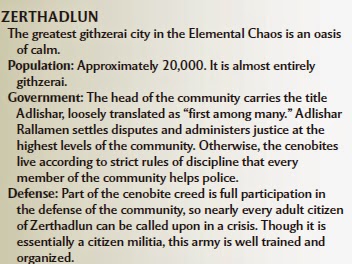
The city of Zerthadlun (new spelling) is described as an austere walled settlement, an oasis of calm where githzerai contemplate order, destiny, entropy and destruction.

D&D 4th Edition Players Handbook 3
This book makes the githzerai a playable race. They speak Deep Speech rather than Gith (4e streamlined the languages).  Male githzerai keep their heads shaved or tonsured and braided. Females wear their long hair close to the head in braids or tight buns.

We also learn that their commitment to asceticism means that they generally disdain displays of wealth and that githzerai live about as long as humans.

Dragon Magazine #378 - Playing Githzerai

This is a giant article by Chris Sims. It covers all the basics, and we learn a few new things.
  • Githyanki means "Children of Gith"
  • Githzerai means "Those who spurn Gith"
Githzerai can meditate and commune with the primal spirits of the world. It is said that Zerthimon meditates forever from within the realm of the spirits, sending his people visions. Some say he might return one day in the form of a mighty spirit.

There's also a paragon path:

Storvakal: A storvakal is a githzerai who meditates in the hopes of leaving the ego behind in exchange for blissful silence. They refer to this as "knowing oneself". They have the power to teleport enemies around, and they can redirect ranged attacks and teleport around.

D&D 4th Edition Manual of the Planes
Life in Limb...err..the Elemental Chaos
Zerthadlun is further detailed in this book. It is a walled city guarded by cenobites, who have taken a vow to obey the community's rules and defend it. They make up 75% of the population and live in communal housing and work in fields.

There are 19 cenobites in Zerthadlun known as The Sustainers. Their job is to meditate and keep the Elemental Chaos at bay. Their retreat is at the exact center of the city.

Secrets of the Elemental Chaos: The Plane Below

This book has quite a bit of information on the githzerai. It mentions a place called the Arsanith monastery, a center of perfect order that is "cloaked from all who are not worthy". Anyone who has found enlightenment is welcome there (even githyanki!).

There is a great sidebar that discusses Zerthimon's fate. It is known that he trained his monks and led the people and then disappeared. Theories:
  • He achieved enlightenment and became an immortal being of pure energy no longer troubled by thoughts of violence against his enemies.
  • Others say he simply died and had a grand funeral.
  • Others say he became a lich and went into hiding, afraid that if this became known, his people would turn away from his teachings. This theory is offensive to githzerai, especially considering that the githyanki are ruled by a lich-queen.
Sanzerathad: A large town in the elemental chaos built on an earthmote at the exact confluence of multiple chaos currents. The effort taken to keep the place from being destroyed is immense. It is said that somewhere on the mote is a room with no doors with something very special inside.

Sanzerathad is ruled by the leaders of two factions:
  • The Blades of Discipline: The protect the physical grounds, patrolling the streets and slaying slaads.
  • The Hands of Order: They spend their time meditating, mentally keeping Sanzerathad from physically crumbling apart.
Liricosa
Liricosa: The only githzerai to achieve true enlightenment. He is a mysterious fellow who wanders the planes with 20 disciples, unfazed by anything. Some think he's actually a creature from the Far Realm in disguise. Each night when he goes to sleep, he tears a page from a book, wets it, and places it on his face.

Dungeon #160 - Den of the Destroyer
This issue has an adventure called "Den of the Destroyer", part of the Scales of War adventure path. It's about gnolls living in an old githzerai monastery called Fortress Graystone. Decades ago, the githzerai vanished without a trace.

The fortress has a githzerai mind trap that teleports you around to different chambers, a training room with a waterfall and aqueducts, a meditation hall protected by githzerai psionic echoes. It is a pretty great location for you to base a githzerai outpost on.

The adventure is pretty good, but it didn't have much to do with the Scales of War path, which was annoying.

Dungeon Magazine #164 - Haven of the Bitter Glass

The Siege at Akma'ad
Another Scales of War adventure features githzerai. It is Haven of the Bitter Glass, probably one of the best 4e adventures ever written.

It's a complicated story, but basically the githyanki are working with Tiamat to kill Bahamut. The githzerai oppose them.

There's some NPCs in this who were pretty popular with my group, including Tokk'it (also known as "Hot Tokk'it"). This adventure kicks off with the heroes having a huge airship fight against the githyanki, and then they go on to help defend a githzerai fortress called Akma'ad against a githyanki siege.

They meet a blind githzerai monk named Odos who drinks a lot of fekk - a githzerai hard liquor. He is dour, pessimistic and suspicious. Check out this flavor:

This is an awesome adventure.

D&D 5th Edition Monster Manual


The githzerai are back in Limbo. "Under the teachings of Zerthimon, who called on his people to abandon the warlike ambitions of Gith, the githzerai focused their mental energy on creating physical and psychic barriers to protect them from attack, psychic or otherwise."

On Zerthimon: "Although Gith won her people's freedom, Zerthimon saw her as unfit to lead. He believed that her warmongering would soon make her a tyrant no better than the mind flayers."

They are lawful neutral. At last!

Mordenkainen's Tome of Foes

This book has a huge section on the githzerai and the githyanki. We learn a lot.

"The githzerai believed that the path to an enlightened civilization lay in seclusion, not conflict."

Zerthimon's Fate: It says that Zerthimon died in the civil war between the githyanki and the githzerai.

The Great Githzerai: We get a pile of new information on the leader of the githzerai/

  • The Great Githzerai Zaerith Menyar-Ag-Gith: Leader of the githzerai.
  • Led the githzerai into Limbo.
  • Has lived far longer than a githzerai normally can.
  • Wields powerful magic and psionics.
  • Can barely move a finger or lift his own eyelids.
  • Never sleeps.
  • Attendants spread his commands.
  • Can psychically contact his people across the planes.

Githzerai: General factoids about the githzerai:

  • Live lives of rigid order.
  • Live for about a century.
  • Often Lawful Neutral.
  • Advantage on saves vs. charmed and frightened.
  • Know mage hand (the hand is invisible). As they gain levels, they learn shield and detect thoughts.

Zerths: They "...fill the symbolic role of Zerthimon in society."

  • Wielders of psionic power who can move themselves and others between the planes.
  • When Zerthimon returns, he will gather the zerths and take them to a new paradise to prepare it for those who follow.

Fortress Cities: The githzerai maintain monasteries that sail through Limbo.

  • Anarchs keep them stable, control them - opening portals to the outside only as needed.
  • Plants are grown in hydroponic chambers
  • Livestock are raised in pens.
  • Always in psychic contact with other monasteries.

Shra'kt'lor: The capital and headquarters of the githzerai military forces. This place was depicted as a huge floating head made out of stone in Planes of Chaos.

  • Most important githzerai meet here to strategize on battling githyanki/illithids
  • Most well-defended githzerai outpost.
  • Teleportation circles are barred, except on the outskirts.
  • Has six layers of nested defenses, each with a fortress maintained by a powerful anarch.
  • Zaerith Menyar-Ag-Gith dwells at the heart of it all.


Adamantine Citadels: Githzerai create these places in Limbo. Menyar-Ag then shifts them to another plane, where they are used as outposts.

  • Attended by an anarch.
  • Contains raw chaos-stuff of Limbo for the githzerai to shape as needed.
  • Has a teleportation circle to Limbo.
  • Life is naturally repelled by a citadel - animals flee, plants wither and die.
  • They are often placed in deserts or remote areas of the Underdark.
  • Citadels are used to watch over enemies, such as an illithid colony.
  • Also used to collect food.
  • When they have no more use for the region, the citadel is abandoned and when the last anarch leaves, the citadel vanishes.

Planescape: Torment

Dak'kon
In the game Planescape: Torment, you meet a githzerai named Dak'kon. Through lengthy conversations with him, you can learn a lot of githzerai lore. There are three main things that I think you should use for your game:
  • Githzerai sayings.
  • The Karach (the githzerai's answer to the githyanki silver sword)
  • The Unbroken Circle of Zerthimon: The bible of Zerthimon, basically. Yes, the game writes the whole thing out.
Githzerai Sayings:

Things your githzerai should say:
  • Githzerai always talk about knowing, truly *knowing* things and places: "The city exists, but it does not know itself. In not knowing itself, its existence is flawed."
  • Farewell: "Endure - In enduring, grow strong."
  • Somber declaration: "In Zerthimon's name."
  • There can be no compromise on this: "There cannot be two skies" (this is a reference to what Zerthimon told Gith after the rebellion).
  • If someone hits on you: "Is it your will that our two paths become one?"
  • None of your beeswax: "Our history does not need to be made known to you. We would bleed to death on time's blade before I recited a fraction of the histories of our people."
  • What the githzerai do in Limbo: "There, we mold the matter of Limbo with our minds. We forge cities with our thoughts. In its chaos we dwell, with only our *knowing* to preserve us. We are the githzerai."

 The Karach:

This is the githzerai's answer to the infamous silver swords of the githyanki. These weapons are wielded by zerths. The karach is a two-pronged blade, made of some metal whose surface swirls like a film of oil on a pond. The blade shifts with the wielder's temperament.

So, if someone says something your githzerai doesn't like: The weapon suddenly turns a flat black, mirroring the githzerai's icy glare.

Talking to Dak’kon in the game reveals that his karach is shaped and sharpened by his mind. Dak’kon’s blade is somewhat degraded due to a spiritual crisis. The Karach is a status symbol, a window to the soul and a companion. As said in the game:

"It is a mirror that reflects the will of the wielder on its surface and in its edge. When one knows themselves, the blade is strong - harder and stronger than steel. When one does not know themselves, the blade is as water - formless and weak."

In the game, the karach has three forms:
  1. Low: "Kinstealer"
  2. Middle: "Chained"
  3. High: "Streaming"
The Unbroken Circle of Zerthimon

This is a round stone made up of a series of interlocking circles that fold out from one another. As you open the stone like a puzzle, text is revealed - the teachings of Zerthimon. From what I can tell, their are eight "circles" to master.

The game actually writes out all eight circles! The entire teaching of Zerthimon. I have re-typed one circle here as I think it gives you a ton of insight into how to make a githzerai work. This story is about Zerthimon's time as a slave of the mindflayers, farming on a field full of githzerai corpses (the mindflayers had sucked the brains out of their skulls).

The Second Circle of Zerthimon:

"Know that flesh cannot mark steel. Know that steel may mark flesh. In knowing this, Zerthimon becomes free.

Know that the tentacled ones were of flesh. They relied on the flesh and used it as tools for their will. One of the places where flesh served their will was the Fields of Husks on the False Worlds of the Illithids.

The fields were where the bodies of the people were cast after the Illithids had consumed their brains. When the brain had been devoured, the husks came to be fertilizer to grow the poison-stemmed grasses of the Illithids. Zerthimon worked the fields with no knowing of himself or what he had become. He was a tool of flesh, and the flesh was content.

It was upon these fields that Zerthimon came to know the scripture of steel. During one of the turnings, as Zerthimon tilled the fields with his hands, he came across a husk whose brain remained within it. It had not been used as food. Yet it was dead.

The thought that the husk had died a death without serving as food for the illithids was a thought Zerthimon had difficulty understanding. From that thought came a desire to know what had happened to the husk.

Embedded in the skull of the husk was a steel blade. It had pierced the bone. Zerthimon realized that was what had killed the husk. The steel had marked the flesh, but the flesh had not marked the steel.

Zerthimon took the blade and studied its surface. In it, he saw his reflection. It was in the reflection of the steel that Zerthimon first knew himself. Its edge was sharp, its will the wearer's. It was the blade that would come to be raised against Gith when Zerthimon made the Prounouncement of Two Skies.

It was then that Zerthimon came to know that flesh yielded to steel. In knowing that, he came to know that steel was stronger than the illithids.

Steel became the scripture of the people. Know that steel is the scripture by which the people came to know freedom."


In case you're curious, here's a quick synopsis of the other circles (the first circle is just the basic origin of the githzerai).

Third Circle: An illithid called Arlathii Twice-Deceased suspected Zerthimon of being a rebel. Zerthimon endured punishment - he was placed on the pillars of silence and was tortured.

Fourth Circle: A githzerai called Vilquar saw no freedom in rebellion. He became a spy for the illithids, answering to a mind flayer called Zhijitaris. Zerthimon tricked Vilquar into thinking the rebellion was over. Vilquar's "reward" from Zhijitaris was that his brain was eaten, as his usefulness had come to an end.

Fifth Cycle: Zerthimon joined with Gith in the rebellion.

Sixth Cycle: Gith's rebellion was successful. Once they were free, Gith wanted to keep killing illithids, and then bring war to other races:

"In Gith's heart, fires raged. She lived in war, and in war, she knew herself. All that her eyes saw, she wanted to conquer."

Gith said that Zerthimon must obey her. She said, "We must be under the same sky in this matter."

"From Zerthimon came the Pronouncement of Two Skies. In the wake of his words came war."

You know what the pronouncement was, right? Zerthimon told her: "There cannot be two skies."

Seventh Circle: Time is an ally, not an enemy. Patience can sharpen even the smallest of weapons.

Eighth Circle: There is nothing that can stand against unity. A divided mind is one that does not know itself.

What I got from all of this is that the githzerai are philosophers - they seek to understand why their lives have been so hard.

Dak'kons Story: (spoilers)

It is revealed in the game that after much contemplation, Dak'kon thinks that Zerthimon is a fraud. He believes that, in the third circle story, when Zerthimon was tortured, he broke under the torturing. He did not endure. Zerthimon became a spy for the mind flayers but got lucky - Gith's rebellion succeeded.

Dak'kon suspects that his "god" and his entire religion might be a lie. And so, his karach wavers. He was one of the people in charge of psychically holding back the chaos in a city in Limbo, and because he was weakened due to not *knowing* Zerthimon, the chaos collapsed in on the city and consumed it during a githyanki assault.

How epic is that?

This completes a trilogy of guides for me. Here are the other two:

A Guide to the Githyanki
A Guide to Mindflayers