Table of Contents - A handy way to check out my articles by topic
My most recent Guides:
As an Amazon Associate I earn from qualifying purchases.
You can reach me at: powerscorerpg@gmail.com

Saturday, July 4, 2015

Dungeons & Dragons - A Guide to the Drow

Today I am going to attempt to write a succinct and informative guide to one of the most popular races in D&D - the drow, also known as dark elves.

Because of the sheer volume of material out there, I am going to cover what I feel are the most essential products that any DM should know about. There's just no way I can do them all. I am avoiding some products because they'd fit better in a Guide to Lolth.

The Essential Information

  • Drow are elves with dark skin.
  • Sunlight causes them pain.
  • Females rule the society, males are subservient to them.
  • They have an incredible array of special items, such as drow sleep poison, death lances and tentacle rods.
  • Most drow worship Lolth, the spider goddess.
  • They live in communal noble "houses" that vie for power and control over underdark cities.
  • Some drow become half-spiders, known as driders.
My Advice on Using Drow

Way back when I was a kid, drow were extremely popular as a player race. Everybody I knew made a dark, angsty drow character who wielded a scimitar in each hand. It was all about doing two attacks per round while looking cool.

As a DM, when I think of drow, I think of a pretty stale monster. But if you dig into the lore and the material, there is a ton of great stuff that brings them to life.

I would highly suggest that you use their special items like the sleep poison and the tentacle rods, play up the fact that the females run things, and make liberal use of the cool monsters like the draegloth, web golems and driders. Definitely work in a demonbinder somehow too, as they are really inspired.

Also, consider making a badass drow NPC with a magic adamantine arm - she breaks the heroes weapons and punches through walls.

Use that sleep poison sparingly, though. Once your heroes get their hands on it, it can be quite a headache.

AD&D 1st Edition


I figured that the drow had a write up in the Monster Manual, but they don't. They just get a blurb in the "elf" entry, which says that they're dark and scary:

Descent Into the Depths of the Earth

A lot of info in this adventure is duplicated in the next one, Vault of the Drow. I'll cover it there. This adventure, by Gary Gygax, involves the heroes battling kuo toa worshipers of Blibdoolpoop. The drow are encountered as wandering monsters and in a few set locations.

Apparently the drow language is known as "Drowic", as it is mentioned when Gary describes writing on a small pin of bronze.

Vault of the Drow

This is a very highly-regarded adventure by Gary Gygax himself and it is part of the "Against the Giants" series. The heroes adventure through a drow city called Erelhei-Cinlu.

We are told that drow items were exposed to "unknown radiations" in the Underdark, giving them magic properties that don't actually radiate magic. These items rot in sunlight, and will be completely destroyed in a matter of weeks:

Drow Sleep Poison: Most drow have javelins and crossbows that use sleep poison.

Wand of Viscid Globs: This wand shoots a gummy substance that can be used to pin people's arms to their sides, or their feet to the ground.

Death Lance: This is a ten foot long spear that fires beams of "negative force" which does 3d4 damage and causes the victim to save or lose d4 levels! These lances have 6 charges.

Demon Staff: They can cause fear, summon a "type I demon" (that's a vrock - a vulture demon), and even transform the wielder into a vrock for 5 rounds!

Tentacle Rods: Drow priestesses have these incredibly deadly rods which have up to 6 tentacles, all of which attack opponents every round.

We get a massive drow entry in the back of the module. The drow were "bitter and cruel" elves driven out by their kin, and they constructed a "gloomy fairyland" underground and now quite enjoy it. They still resent the elves for what they did.

Drow have black skin and pale hair. Males have eyes of orange, while females have eyes of amber or violet. Daylight causes them pain, giving them -2 to hit and they'll flee if possible.

The Drow have a silent language composed of hand movements, in addition to their spoken language.

Fiend Folio

The material from Vault of the Drow is reprinted in the Fiend Folio. Not much more to learn, except that there is a pretty cool piece of art by Jeff Dee:

Dragon Magazine #60 - All About Elves


This issue has an article about elves, which is punctuated by a very in-your-face piece of Erol Otus art of what I presume is a drow priestess of Lolth.

I have to include another piece of art from this article, too. This depicts what I guess is a high level elf overloaded with magic items:

The article only briefly mentions the drow, saying that they are hated amongst other types of elves (high elves, gray elves and sylan elves) more than orcs. This article also has a bit of discussion on how female elves in the elf army are unicorn riders, which is pretty fun.

Unearthed Arcana

Drow are presented as a playable race in this book. They are outcasts, don't have drow items, and do not have their innate magic resistance.
  • Light Sensitivity: Daylight causes a -2 to hit, and spellcasters have to make concentration checks to cast spells. Ouch.
  • They can case dancing lights, faerie fire and darkness once per day.
  • Here's the big one: Drow can fight with a weapon in each hand, off-setting the normal penalties by +2.
  • Drow can't be barbarians or monks.
AD&D 2nd Edition

The Monstrous Manual drow entry is quite similar to the 1e stuff.
  • Drow cloaks and boots basically give them 75% invisibility. Direct sunlight destroys this stuff in 2d6 days.
  • In drow society, Lolth tests drow who hit 6th level. Those who fail the tests are magically transformed into driders - monsters that are half-drow, half-spider. They become outcasts who favor blood over all other types of food.
  • Drow live for about 800 years.
The Drow of the Underdark

This Forgotten Realms sourcebook is written by Ed Greenwood, and it is fantastic. I'd go so far as to say it is one of the greatest sourcebooks of all time. It is completely overloaded with inspired ideas, and it is written in a very breezy manner.

This is going to be long, but you might be shocked to know I am presenting only a fraction of the cool stuff in this book.

The Test: We get details on how Lolth tests certain drow wizards when they hit 6th level. They are abducted and given a "...thorough magical mind-reaming...". Those who fail are turned to driders through magical ceremonies performed by Lolth's yochlol (shapeshifters).

Driders: They're feared by the drow, they hang out with spiders and they are genderless.

Slaves: Drow keep slaves (usually goblins, orcs and hobgoblins) and treat them very poorly. Slaves are not allowed to look drow in the eye.

Customs: Drow like to give "...long, skilled massages involving scented oils, hot water and steam". Construct your encounters accordingly, my friends.

House Insignia: Drow carry magic tokens fashioned in the shape of the recognized symbol of their house. These items are enchanted, and there's a huge list given of minor and magic powers you can apply to them. Minor powers include comprehend languages and feather fall, while major powers include dimension door and wraithform. When touched by someone other than the drow attuned to it, it can deliver harmful effects including burning the victim or causing them to lose their voice for 2d4 days.

Drow Society:
  • Women run drow society.
  • Social standing is the most important thing. To ascend, one must assassinate those above them.
  • Spiders live among the drow. Drow have a great affinity for them.
  • There are two major social groupings: Merchant clans (usually run by males, as trading with outsiders is considered demeaning) and noble houses (the "...mothers of whom often live thousands of years, kept alive by Lolth's magic").
  • Females can choose and discard mates freely, killing the males they've tired of. Marriages last 1-10 years. Any children showing physical deficiency are slain.
The Blooding: A rite of passage into adulthood. The drow must kill an intelligent or dangerous surface creature.

There's a pile of awesome spells, including:
  • Spidereyes: Allows a drow to peer through the eyes of a spider spy.
  • Dark Wings: Gives the drow bat wings, allowing them to fly.
  • Passweb: Confers the ability to walk through webs, rope and vine. Very handy for dealing with web spells, which were crippling in second edition.
We get details on the different types of tentacle rods. You need to be an evil priest to use them, as well as wear a control ring.
  • Purple: 3 tentacles, slow the target if they all hit at once.
  • Red: 3 tentacles, if they all hit the target is slowed and one limb is weakened - it cannot be used to strike, grasp or carry things for 9 rounds.
  • Yellow: 3 tentacles, if all three hit at once the target is dazed for 9 rounds.
  • Amber: 6 tentacles, if they all hit, the target is soul-burned. They burst into flame and lose d6 hit points permanently!
  • Black: 6 tentacles, if all 6 hit the victim is soul-chilled. The victim takes internal cold damage and loses d8 hit points permanently.
  • Jade: 6 tentacles, if all 6 hit the victim is feebleminded until a heal spell or wish spell is cast.
  • Violet: 6 tentacles, if all 6 hit the target is blinded for 3 rounds and loses 1 point of Dexterity for 2-5 years.
There's many other cool items:
  • Staff of the Abyss: Does damage that can only be healed at one point per day. The wielder can summon vrocks and transform into a glabrezu.
  • Wand of Darkness: It can cast darkness spells, it can break protection from evil circles (!), it can summon a nightmare which serves the wielder, and it can animate dead.
  • Driftdisc: Magically-animated 6 foot diameter discs that drow use to travel around in cities. Some drow use them as beds.
  • Walking Chest: There are strongchests or cargo boxes with legs of a dead giant spider. They can be controlled with a control ring. They are known as "crawlchests". Supposedly there are "crawlchariots" as well, fitted with harpoon guns.
  • Death Lance: They are made of dull gray metal that, when it hits a target, causes dark tendrils to drain the victim of 1 level.
  • Whip of Fangs: These are like the tentacle rods, except they have living snakes on them! These are often used on slaves and male relatives.
Then we get even more good stuff on crafted items:

Drow Poison: It is black and gummy, quite like molasses. A victim must save at -4 or fall unconscious at the end of the round. The drugged slumber lasts 2d4 hours. The drow have built up a resistance to this poison, saving at +7 (I suppose in 5e they'd have advantage).
Adamantine Limbs: Some drow who lose a limb replace them with magic adamantine constructions. Some of these have removable parts, or attachments - a drow might have a spiked mace head attachment.

This book even has pages of drow words and sayings:
  • Elgg - Kill, slay, destroy
  • Rivvin - Humans
  • Sarn! - Beware! Warning!
  • Ssinssrigg - Passion, lust, greed, longing, love
  • Oloth zhah tuth abbil lueth ogglin. - "Darkness is both friend and enemy."
  • Lil alurl velve zhah lil velkyn uss. "The best knife is the unseen one."
  • Jal khaless zhah waela. - "All trust is foolish."
We also get monsters. There's one in particular that is handy.

Yochlol: The "handmaidens of Lolth" who live in the Abyss. Drow can summon them with rituals. They can appear as columns of gas, or an amorphous column with one eye, or even a giant spider or beautiful female human or elf. They can contact Lolth telepathically.

You can buy this book here.

D&D 3rd Edition
3rd edition Drow are smaller than normal elves and have red eyes. If you fail your save, their poison knocks you out for at least a minute, and could last as long as 8 hours. Light blinds and dazes them.

Drow of the Underdark

This is quite like the 2nd edition book, and is full of good stuff. It has lots of prestige classes, monsters, spells, feats, adventures, and even an entire chapter on the drow city of Erelhei-Cinlu (the city from Vault of the Drow).

Females dominate drow society because drow females are like female spiders - they are stronger than the males and the males sometimes do not survive the mating process (!).

We get details on different tests of Lolth:
  • Test of Loyalty: Lolth sends a drow a vision. The drow must prove to be willing to slay one of her own allies at Lolth's command.
  • Test of Strength: Simple combat with a rival or a monster. Defeat or showing mercy constitutes a failure.
  • Test of Lies: The drow must trick individuals into believing lies.
  • Test of Mettle: The drow is stuck in a pit or confined space, and is covered with venomous spiders. She must survive and escape without harming any of the spiders.
  • Test of Doubt: A drow is stripped of everything, and is sometimes even turned into a drider. She must survive and thrive despite the setback.
Having a Drow Baby: Drow mothers are not given aid in childbirth: "Should she die in the process, she is clearly too weak to contribute further to the race anyway." Drow children are raised by servants and are encouraged to solve problems with violence.

Leisure: Drow drink wines brewed from underground fruits, mushrooms and fungus. They also like inhaling herbs and incense that causes hallucinations or euphoria.

Demonbinder: This is a prestige class - A drow who has absorbed the essence of a demon and wields demonic power. As far as game mechanics go, demonbinders spend "damnation points" to invoke the essence of a demon. The amount of points you spend buys you a different demon's traits. Here's a few examples:
  • Succubus: You grow useless black wings, gains temporary hit points, use of the tongues spell and a +5 to bluff and diplomacy.
  • Glabrezu: Your hands become crab claws, you gain 30 temporary hit points, true sight and +5 to bluff.
  • Marilith: You grow four arms, your legs fuse into a serpent's tail and your eyes glow with an unholy light. You also gain the ability to cast eldritch blast.
There's piles of magic items, and even two artifacts:
  • Cloak of the Consort: It gives you +6 to your AC and protects drow from light. It also grants concealment for ten rounds.
  • Egg of Lolth: A fist-sized egg made of platinum. It summons a bag that summons swarms of spiders that attack all non-drow. Anyone touching the bag is sucked into the Demonweb Pits.
There's many monsters listed. Draegloths became sort of prominent during this time.


Draegloth: "Draegloths are fiends born from profane unions between drow high priestesses and powerful demons". Draegloths are huge humanoids with 4 arms, white hair and a bestial face with an elongated muzzle.

Albino Drow (Szarkai): These drow look like surface elves. They are rare mutants trained in espionage from birth.

D&D 4th Edition

In 4e, drow were once creatures of the Feywild. Lolth led them down a sinister path. We get some interesting types of drow:

Drow Warrior: They use rapiers, can fire off darkfire as a minor action (which prevents the target from being invisible or concealing themselves), and they use weapons coated with drow poison. In 4e, the poison, weakens on the first failed save, and knocks you unconscious until the end of the encounter on a second failed save. That is no joke in 4e, as your player might be sitting at the table doing nothing for 20 minutes.

Drow Arachnomancer: She has a spider rod that immobilizes, can shoot poisonous venom rays, cause spiders to swarm the target, and can create clouds of darkness that block line of sight.

Drow Bladmaster: Can attack many foes at once with his blades.

Drow Priest: She casts pain webs, can blow up an ally and release spectral spiders that bite all enemies within 25 feet, and can even heal herself by transferring her damage to a drow or spider ally.

Forgotten Realms Player's Guide

This mentions that drow now live for up to 200 years, although "...exceptional members of the race measure their age in centuries".

They trance instead of sleeping. They also get either darkfire or cloud of darkness as an encounter power.

Demon Queen's Enclave

This is a well-regarded 4e adventure which involves the heroes coming to a drow settlement to deal with a cult of Orcus. While there, they get entangled with the machinations of a drow vampire.

I am including this because it includes web golems, which I think are a cool monster that you should consider using:
Web Golem: These are golems made of webbing. They can grab up to two enemies and are extremely sticky. In fact, if you hit them with a melee weapon, your weapon or you might get stuck to them. When you kill a web golem, it explodes, causing you to be stuck in a sticky web. There are also Web Golem Threshers, which can spit webbing.

Underdark

This 4e supplement had a mishmash of stuff for you to use in an underdark campaign.

The Fall and Rise of the Drow: The book explains that the drow fled to the underdark after a war with the eladrin. The Underdark in the 4e cosmology (the world of Nerath) is ruled by this guy named Torog.

Torog, "the God that Crawls" (god of imprisonment and torture), was imprisoned in the primeval underdark. In his efforts to escape, he carved tunnels in the underdark, and even carved into the feywild and the shadowfell, creating the feydark and the shadowdark, respectively. He's still down there, and has a central network of torture dens, served by depraved painseekers.

Torog destroyed a drow city but then made peace with Lolth.

Mark of the Drow: This is a campaign outline. In it, the heroes begin as slaves of the drow. They were born with a special mark and are known as "the gladia", adventurer-slaves celebrated by the drow. They will have the opportunity to become drow themselves and eventually battle against the cult of elemental evil. Deep into the campaign, they learn the secret of their marks, which is pretty crazy.

Erelhei-Cinlu: The book gives a nice little summary of Erelhei-Cinlu. There's a nice quote on how the drow perceive themselves. They see themselves as "...dewdrops on the web of Lolth".

Dragon Magazine #412 - "A Tangled Web - The Origins of the Drow"

James Maliszewski writes a brief article on the drow. We learn that the city of Erelhei-Cinlu got its name from the first two letters of the names of Gary Gygax's kids: Ernie, Elise, Heidi, Cindy, and Luke.

Dragon Magazine #413

This issue is full of drow "character themes", detailing different sorts of drow usable in running drow. These were made with Neverwinter and the Forgotten Realms in mind, but they can easily be transplanted to any drow society.

Elderboy: These are favored drow males, a matron's oldest living son. They play by the matriarchy's rules - at least when others are looking. They have a hilarious set of powers, including "Endure Torment", "Shift Blame" and "Beg Lolth's Favor".

Melee-Magthere Champion: Warriors who attend a school devoted to martial pursuits. All noble male drow are expected to attend, sometimes females do as well.

House Priestess: Her societal status is like a political office. "One day, you will succeed your matron mother — most likely by the edge of a sacrificial blade. Until then, you lurk and scheme, weaving a web of intrigue." A house priestess has a power called "Obey Your Betters", which enables her to reroll a diplomacy or intimidate check with a +4 bonus.

Ooze Master: These rare drow abandon drow society to worship Ghaunadaur, god of oozes. They fight constantly against whispers of madness and they can summon corrosive acid to do their bidding. They have a power called "Sudden Slime", which is a ranged attack that causes an explosion of green slime. They also have "Pudding Sight":


D&D 5th Edition

I really dislike the art of the drow in the monster manual. I decided to use this Rise of the Underdark cover instead.

Now that we've waded through the main stuff that came before, let's see what the 5e monster manual has for us:
  • The good elves banished their malevolent kin to the subterranean depths after a war. There was only one elven deity who hadn't forsaken them - Lolth.
  • The drow worship Lolth and believe they are destined to be rulers of darkness.
  • Their magic equipment now loses their magic after one hour in sunlight. It keeps getting shorter and shorter.
We get stats for a few different types of drow. Most of it is similar or identical to what came before. Drow mages can summon a shadow demon once per day. Drow Priestesses have pile of spells and can summon a yochlol once per day.

In the player's handbook, we see that if your drow is in direct sunlight, he or she has disadvantage to hit and on Wisdom (Perception) checks. I completely forgot about this in my public play games!

The picture of the drow in the PH is actually of Drizzt. They even mention Drizzt in a sidebar as an example of a drow hero that a player could model their character after.

Major Drow Deities

The gods of the drow are known as The Dark Seldarine.

Lolth: Goddess of the drow, demon queen of spiders. She lives a layer of The Abyss known as the Demonweb Pits. She's one of the major villains in all of D&D, and has appeared in many adventures and novels.

Eilistraee: Goddess of song, beauty, and good drow. Her female followers are all musicians.

Ghaunadaur: God of oozes. He's an amorphous purple blob with roper servants. Ed Greenwood's Drow of the Underdark book claims he is The Elder Elemental God, but that has since been revealed to be Tharizdun.

Vhaeraun: The drow god of thievery. He is also the god of drow males opposed to the matriarchy of Lolth. He wants the drow to claim land on the surface and found a society where the sexes are equal.

Drizzt Do'Urden

You can't really talk about drow without mentioning this guy. He's the star of 20+ D&D fantasy novels and one of the most popular NPCs in D&D history. Drizzt is the archetypical "good drow" who battles the darkness inside of him.

Fun Facts about Drizzt:
  • His name is not pronounced "Drizz It". It's "Drizzzz(t)".
  • He has a magical black panther named Guenhwyvar. He summons it from the astral plane with an onyx figurine.
  • He spent ten years in a "bestial" state of mind, hunting in the Underdark. He snapped out of it when he almost brought harm to some gnome children.
  • Rapper/actor Ice T is a big Drizzt fan.
  • Drizzt was created by author R.A. Salvatore at the last minute to be a sidekick to the hero of The Crystal Shard, Wulfgar.
Go here for more info on Drizzt. You can also go here for info on every book, comic and board game.

Full disclosure: My brother ran Drizzt as a character in an AD&D second edition campaign I ran in the early 90's. He committed murder in a city and he got thrown in jail. He never escaped. 1,000 years have passed in he game since that happened. So in my campaign, Drizzt died in prison. 

Hopefully this will help us get set for Out of the Abyss, which comes out in September as part of the Rage of Demons storyline. It's set in the underdark and Drizzt is heavily featured in the promo art . From what I understand, the heroes help Drizzt, or Drizzt gets possessed...? I guess we'll see soon enough.

Wednesday, July 1, 2015

Dungeons & Dragons - A Guide to the Slaad

Today we're going to take a good look at a really weird monster: The Slaad. My hope in writing this is to give you a nice base of information to draw from for when you use these monsters in your campaign.

The Plane of Limbo

One of the most important things to note is that the slaadi ("slaadi" is the plural form of slaad, except in 4th edition) live in a plane called Limbo. The 5e monster manual does a great job of describing this place:

"In the Ever-Changing Chaos of Limbo, bits of forest and meadow, ruined castles, and isolated islands drift through a tumult of fire, water, earth, and wind. The foremost inhabitants of this inhospitable plane are the toad-like slaadi."

People with high intelligence who go to Limbo can shape the chaos with their mind, to create safe places to travel or live. This is how the githzerai exist in Limbo.

Essential Information

Here's the basics:
  • Slaadi come in different colors, and each has its own abilities. 
  • Many slaadi can"impregnate" victims with tadpoles that explode out of their chests, killing them. The condition of having a tadpole in you is known as "chaos phage".
  • There are a few slaad lords, the most powerful of the slaadi. Ygorl, Ssendam and Renbuu are my favorites.
  • Slaadi have gems in their brains which, if drawn out of them, can be used to control them.
  • There's a massive floating stone in Limbo that the slaadi are drawn to. It is known as The Spawning Stone.
  • Check out the stuff in Plane Below, which gives a really cool take on the slaadi - that they are from multiple realities.
AD&D 1st Edition

The Slaadi get a huge section devoted to them in the Fiend Folio. We are told they are frog-like beings who live in the plane of Limbo.
  • They can be summoned by spellcasters via the cacodemon spell.
  • They can understand and speak any language
  • This is crazy. They have jewels in their brains that contain their life force. If someone was to threaten to destroy it, the slaad would  grant the person three requests. Removing the gems would require a spell like power word:stun, limited wish or trap the soul.
A few different types of slaadi are detailed. I am going to list them from lowest rank to highest rank:

Red Slaad: These slaadi are slavers. When they slash someone with their claws, there is a 40% chance that person must make a saving throw or die in 3-36 hours!

Blue Slaad: They are ten feet tall and run errands for higher ranking slaadi. Blue and Red slaadi do not like each other. They have the power to use telekinesis, passwall and hold person.

Green Slaad: These slaadi have 50% magic resistance, a pile of powers and once per day they can cast a fireball that does 12d6! If they die but heir gem remains intact, they are reborn as a blue slaad in 24 hours After a year, they revert to the form of a green slaad. How weird.

Gray Slaad (The Executioners): These slaadi often have swords of sharpness and they have all sorts of spells like power word: blind. They also have the ability to create magic items.

Death Slaad (The Lesser Masters): Only four of these exist. They can take a human form and usually wield magic swords. They have a million powers, including invisibility, flame strike and cloudkill.

We are also given details on some slaad lords, which are really crazy.

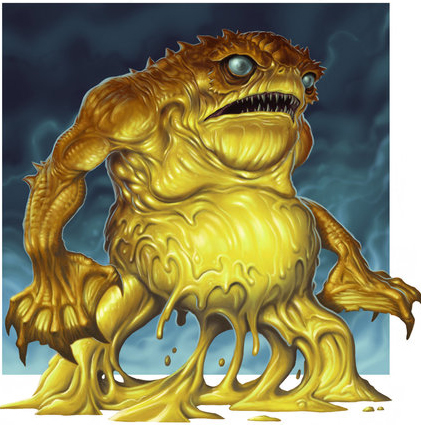
Ssendam, Lord of the Insane: This thing is a golden amoeba with a brain in it. It sometimes wanders around as a naked dude with a black sword that stuns anyone it strikes. In Limbo, Ssendam takes the form of a large, golden slaad.

What an absolutely awesome NPC. Ssendam is criminally under-utilized.

Ygorl, Lord of Entropy: Ygorl is a skeletal, bat-winged man with a sickle who is always in shadow. He can command undead. Those struck with the sickle must save or die. Ygorl rides a brass dragon named Shikiv. In Limbo, he takes the form of a 15 foot tall black slaad.

Manual of the Planes

In the section on Limbo, the slaadi are "intelligent messengers of chaos". Gods and planar powers use them as messengers, warriors and servants. We get some details on where the slaad lords live:
  • Ssendam lives in a golden castle
  • Ygorl lives in a series of carved spheres that traverse the five layers of Limbo.
Tales of the Outer Planes

Wartle
I've mentioned before how this adventure anthology was one of the great disappointments for me in all of D&D. Imagine my dismay when I discovered that this book presents a new slaad lord! Who knows, maybe it will be cool.

First, there's a slaad adventure in here. The heroes are hired to claim the gem of a grey slaad named Zdronvas. He lives in this maze that, once you're in it, only a wish will get you back to the entrance.

Wacky stuff happens in the maze. There's blind orange mice. Loud music.. "rock, jazz, classical, country - DM's choice"... plays. Wildflowers sprout from the heroes ears. There's even monkeys carrying typewriters. Not kidding! I won't spoil the secret of the maze, but it's totally random and annoying.

Wartle actually appears further in the book, in an adventure set in the goodly plane of Celestia. Ygorl has encased Wartle in a meteor and sent him crashing to this realm. The meteor is spreading chaotic energy, corrupting the good creatures of Celestia. The adventurers must solve this problem.

Wartle actually has his own stat block and everything.
  • Slaad form: He is a brown, short slaad with backward-pointing horns.
  • Human form: He's a short pudgy guy with a whining raspy voice.
Wartle is always covered in warts, lies a lot ..."and (most of all) crude". Wartle "...rudely and regularly insults the other slaad masters, and has more than once suffered from their violent ire".

There's a nice entry on him on the forgotten realms wikia. Wartle is barely referenced after this appearance. That's probably for the best. He doesn't really fit with the others.

AD&D 2nd Edition

Planescape really goes to town with these guys. We learn a lot of new things in the outer planes appendix and the Planescape Boxed Set:
  • The slaadi each have a symbol of power embedded in their foreheads, which signifies their achievements and status.
  • Red Slaad now emit a croak that stuns those within 20 feet for 2 rounds. Their ability to implant tadpoles is expanded upon - a blue slaad tadpole explodes out of the victim's chest after 3 months.
  • Blue Slaad now have a bite that basically gives the victim mummy rot. Then a bit further below, it is said that a blue slaad can infect a victim, causing them to turn into a red slaad over the course of three months.
  • Once in awhile, a victim infected by a blue or red slaad instead "gives birth" to a green slaad. These are nurtured by the red and blue.
  • Once a green Slaad lives for 100 years, it goes into seclusion for a year and then returns as a gray slaad. It seeks immortality from this point forward.
  • There are about 6 death slaadi. They achieved near-immortality through evil ceremonies. They direct slaadi efforts, sending slaadi to raid settlements and imprison the locals so that they can be used to spawn more slaadi.
Dragon Magazine #221

Ygorl
This issue has a gigantic article on the slaad lords. It gives more detail to the original 2 from the fiend folio, and also presents two new ones.

There's an interesting note on the lifespan of the slaadi. When they reach a certain age, they travel deep into Limbo. Most of them dissolve into their base essence and merge with the plane. A few ascend and become slaad lords, whose power rivals those of demon lords.

Ssendam, Lord of Insanity:
  • Ssendam is female! She's a golden amoeba that devours anything that comes too close, and is the oldest of the slaad lords.
  • She can take the form of a huge golden slaad.
  • She can also take the form of a beautiful golden-skinned female elf warrior with a wisdom of 0!
  • Ssendam is feared even by her own kind. She has no followers, no friends. She believes that insanity is the true form of chaos.
  • This is not a typo. She has 41, 251 hit points! All of the slaad lords have 25,000+ hit points. The author went a little overboard.
  • She is the self-appointed guardian of the spawning stone.
Ygorl, Lord of Entropy:
  • He lives in an ever-changing keep (I prefer the spheres from 1e).
  • He's a huge, skeletal winged slaad made of black bones.
  • Ygorl tries to lead the slaadi. He organizes efforts to create new slaadi and is even grooming a death slaad named Sorel to become a new slaad lord.
Chourst, Lord of Randomness

  • He is a 20 foot tall white slaad.
  • Chourst basically has ADD. He'll leave a fight mid-combat because it doesn't hold his attention.
  • His presence dissolves chaos-shaped land in Limbo.
  • Spells cast near him always trigger a wild surge.
  • It is said here that Ygorl created the Spawning Stone
Renbuu, Lord of Colors

  • Renbuu is 12 feet tall and his skin swirls in different radiant hues.
  • Get this: He roams the planes changing the colors of beings and things! How amusing.
  • He has the power to transform creatures of one color/type into another! Crazy.
  • He lives in a pristine and impregnable gallery (Renbuu is an artist) deep in Limbo.
  • There's some great details on the things Renbuu likes to do. He has turned some drow white. He turned gold dragons black! Amazing.
Renbuu walks the fine line between stupid and inspired perfectly. I'll have to work him into my Planescape campaign somehow.

Planescape - Planes of Chaos

There's a bit of talk about how slaad revere personal strength. Their forehead markings denote their power. They fight for food and to prove who is toughest.

There's also details on the Spawning Stone. It says here that slaadi come to the stone to mate. Death Slaads can used the power of the spawning stone as if it was a chaos-shaper. I don't understand why they're mating when they create slaad through chaos phage..?
  • The spawning stone is blue-gray and bent like an enormous horseshoe. The interior is said to have circular rooms.
  • Without the Spawning Stone, all slaad eggs are infertile.
  • Non-slaads are not allowed within miles of the stone, on pain of death.
  • There's also an adventure in Limbo in this boxed set called "Deliverance". There's a gray slaad leading raids on a Limbo settlement. The heroes must go to the gray slaad and summon a champion who can defeat the gray slaad.
There are two great packs of slaadi who hang out at the spawning stone:
  • The Lone Claw: A mass of red slaadi led by a gray slaad named  The Sorrowful Executioner. They go on raids, and are uniting for something mysterious.
  • The Quick Tongue: Blue slaadi led by a death slaad named Thurupl the Kicker. Thurrupl is one of the few slaad who other slaadi will obey.
As far as I know, these gangs are never referred to again.

On Hallowed Ground

Renbuu
This Planescape book details piles of deities, demon lords and other entities. It goes over the slaad lords. It claims there are only four:

Ssendam: She has mental powers that can drive people mad.
Ygorl: Ruler of the slaadi.
Chourst: He is "whimsy incarnate".
Renbuu: He has a mane of white hair (?). There's even art of him.

Tales from the Infinite Staircase

This planescape adventure has slaadi all over it. The main story is about the Iron Shadow, a thing of order that is draining away inspiration and the will to change, leaving only lethargy and apathy in its wake.

One of the adventures in this anthology is called "In Disarray", and it features the slaadi. It involves a trip through Limbo where we meet with a few githzerai linked to the slaadi:

Torpellin of the Golden Spires: She actually lives among the slaadi at The Spawning Stone, and she has a slaadi forehead symbol. She is accepted among them.

Cahm'Fel: A githzerai enduring a self-imposed exile from his people. He reveres the concept of change itself. He created a huge floating monastery in Limbo. In it is an "altar of change", which he uses to change his appearance. In this adventure he takes the form of a three foot tall human female with deep violet skin and long crimson hair. He is accompanied by a pretty major slaad entity:

Phlegamor, the Maze Master: Phlegamor once served the slaad lords Ygorl and Ssendam. They mutated him into a gigantic and powerful guardian. He fell out of favor and was cast aside. Now he lives in a maze in Cahm'Fel's temple,. He has no real corporeal form, and he commands animated servants (corpses of those previously slain in the maze).

This adventure also features a really cool secret of the slaadi:

Secret Nursery of the Slaadi: In a place near the Spawning Stone, there's over 100 slaadi chained together. These slaadi are mutants, all with different forms like four arms, or 20 feet tall, etc. These are the true slaadi, beings of ultimate chaos. Each one is an entirely new breed of slaad!

Ygorl and Ssendam put all of these creatures here to limit the types of slaadi, to make it easier to control them. In this adventure, the heroes free an orange slaad, feed it distilled essence of chaos and send it rampaging on the Spawning Stone, which helps the slaadi shake off the Iron Shadow.

D&D 3rd Edition

3rd edition really didn't know what to do with the slaadi. Lots of weird, uninspired stuff.

Now the Slaad speak their own language as well as common. The red slaad implant eggs into victims when they are unconscious. The eff gestates in one week. The blue slaad ability to turn people into red slaadi now drains charisma. Once the charisma is at 0, the victim immediately becomes a red slaad.

Not much in the way of changes at all.

Epic Level Handbook

This book details two types of slaadi - Black slaadi and white (!) slaadi.

White Slaad: A death slaad sometimes goes into isolation for a year and returns as a white slaad. It can spit globs of chaos and shatters weapons with its claws.

Black Slaad: Similar to the white slaad in origin, these guys can see in darkness and have long tongues that split into four parts.

Fiend Folio

Mud Slaad: I almost didn't want to include these in this article. These guys are brown and even weaker than red slaadi. They are cowardly and insecure. They actually have the power to "cringe", which can compel the attacker to o be unable to follow through with the attack.
  • Their bite turns the victim into a mud slaad over the course of the week.
  • They have a sonic screech which does 5d6 damage!
  • They can feign death.
I don't think I'd use these guys. The cowardly trait and the feign death ability are fun, but don't seem to fit the whole slaad concept. This whole thing feels like a mistake from start to finish.

Dragon Magazine #306


The Gormeel: These are lawful slaadi, a fluke breed born from the spawning stone.
  • Gormeel are reptilian, gray-green humanoids who are sort of like apes in that they get around using all four limbs. They have lizard heads. 
  • Githzerai team up with them to battle the slaadi, and even use them as mounts.
  • They have the ability to take the form of a githzerai..!
I like the idea of lawful slaadi, but this feels like another mis-step.

Dungeon Magazine #101 - Prison of the Firebringer

Bazim-Gorag, slaad lord
This issue has a high level Forgotten Realms adventure that features another slaad lord - a two-headed slaad named Bazim-Gorag. Bazim is trapped in a vault and bad guys are trying to unleash him on the world.

To free him, three wizards must use a scepter in a specific room to perform a ritual. One wizard must be lawful, another chaotic and the third neutral.

Bazim-Gorag the Fire-Bringer: He has two heads. He can take a human form of a guy with bronze skin, red eyes and he wields a glaive sheathed in black flame. He has an aura of flame, and he can make incinerating attacks.

There's really not a whole lot of detail on his motivations or backgrounds. He's said to be as powerful as a demon lord, and he seems to have be very into fire. A little more digging reveals that he is steeped in Realmslore.

D&D 4th Edition

4e really went to town with the slaadi. Get ready.

In 4e, there is no Limbo. The slaadi were moved to the elemental chaos. Also, a name has been given to their ability to transform others into their kind: Chaos Phage.


The plural form of slaad is "slaads" in 4e, which I prefer. Slaads believe they were the first creatures in the cosmos, and they spread chaos. All slaads now can teleport every round as a move action.

Black slaads are also known as void slaads and they get a cool new look. In fact, each slaad is given a more defined role and a new sub-name. Older versions had a big wad of spell-powers. These have a few specialized ones:

Gray Slaad (Rift Slaad): Gray slaads are now the weakest of the race, replacing the reds. They can cause planar instability (sliding people around and knocking them over), teleport and become insubstantial.

Red Slaad (Blood Slaad): They still infuse people with embryos, but it now has an official name: Chaos Phage. Chaos phage is presented as a 4e disease. Their croak now immobilizes instead of stuns.

Blue Slaad (Talon Slaad): They also dole out chaos phage. These guys are more like the hulk, stomping around and pummeling people.

Green Slaad (Curse Slaad): They can fire chaos bolts that daze, they can teleport in a way that allows them to switch places with an enemy, and they can let out a "croak of chaos" that slides enemies 20 feet.

Black Slaad (Void Slaad): They drain healing surges with their claws, fire rays of entropy and can create zones of oblivion which blocks line of sight and does damage.

Manual of the Planes

The book goes over old material, and theorizes that slaads were once demons that broke free of the Abyss.

Monster Manual 2

Slaad Spawner
This book has more slaad variations:

Flux Slaad: These slaads slip through weak points in the planes and end up ruling tribes of bullywugs (?). They are small and weak compared to other slaads.

Slaad Spawn: This is a slaad that just exploded from the chest of its host body. It must "...eat swiftly and well, or the chaotic energies contained within its body become unstable and explode."

There's also a template for "slaad spawners". Some slaads spawn through budding. Boils appear on their body, and new baby slaads pop out (like in gremlins).

Monster Manual 3

Golden Slaad: Sometimes when a chaos storm washes over a slaad, it becomes an unstable, gooey golden slaad. It can emit a chaos croak that has random effects. It might teleport someone in a random direction or stuns them. When you reduce it to half its hit points, it becomes an ooze that attacks with pseudopods.

Putrid Slaad: Necromancers can transform slaads into these things, which eat people and then spew the remains at new targets.

The Plane Below

This book is overflowing with awesome ideas.

There's a sample encounter/skill challenge for if the heroes need to try to reason with a slaad. It could come down to a pretty fun random chart:

There's a couple of pages detailing slaad life. It talks about their conflicting origin stories, and how all might be true because they can see alternate realities:

"Perhaps multiple universes collapsed into a single cosmos, and only slaads still remember the infinite possibilities of other timelines. Now trapped in a single reality, they rebel against its strictures and embrace chaos as a way of breaking free into the wider multiverse."

What a cool idea. The rest of the slaad stuff in this book builds on this concept.

The Great Red Tempest: There's a place in Limbo called the Great Red Tempest. Slaads like to follow around chaos storms, and this one is miles across. There's a void slaad named Vinakr Abudn who meditates here, seeking to find a way to use it to tear down the walls of creation.

The Spawning Stone: There's new info on the Spawning Stone. Now it is a few hundred feet in diameter and it has burning white runes on it. The stone is protected by a slaad known as The Guardian of the Stone. It seems like poor Ssendam has gotten written out of continuity. That's a bummer, I thought Ssendam was awesome.

Then we get a bunch of new variants of slaads:

Chaos Phage Swarm: This is a swarm of slaad tadpoles that can infect victims with chaos phage.

Green Slaad Madjack: These slaads can give victims maddening visions and cause mind spasms (which daze the enemy).

Blue Slaad Digester: These guys eat a lot. They think they can eat enough of reality to force the true nature of the multiverse to shine through. They spew acid and can knock you prone with their tongue.

Gray Slaad Havoc: They can fire havoc bolts and create a fog of chaos which causes people in it to attack each other. It can also shift reality, allowing it to teleport people around.

Red Slaad Juggernaut: This is a 15 foot tall red slaad who pummels victims with giant claws.

White Slaad (Chronos Slaad): The chronos slaad can pull replicas of itself from the past and future! It can splinter into 6 versions of itself.

Black Slaad Entropic: These are 26th level minions (that means they have just one hit point). It can turn itself into an entropic void, which has its own monster stat block. The void draws you in and sucks the life out of you.

Entropics serve Ygorl, the slaad lord.

Norsar the Many: There's a mention of a white slaad lord named Norsar the Many. He has translucent skin and can pull hundreds of replicas of himself into the present.

Last but not least, this book details Ygorl. He gets a really cool redesign that really sets him apart.

Ygorl
Ygorl, Lord of Entropy: Also known as "The Bringer of Endings". Ygorl is basically walking death.

Shkiv: Ygorl's dragon. He is infused with chaotic energy that corrupts those around him. The dragon is old and withered. It breathes a random breath weapon - cold, fire, thunder... even psychic!

Get a load of this: "Slaad legends say that Ygorl came into being when the universe died and now moves backward through time."

Skirnex, Voice of Ygorl: This slaad is a sort of pseudo-priest, a three-armed void slaad. He may have been touched by the emanations of the far realm.

D&D 5th Edition

Their lore has been tied to that of the modrons. Basically, Primus tried to create order in the chaotic realm of Limbo by sending a huge law-stone into it. Instead, the stone absorbed chaotic energy and spawned the slaadi. This stone is known as The Spawning Stone. Slaadi attack modrons on sight.

The red and blue slaadi are given back their separate ways of creating others of their kind, though the name "chaos phage" is kept.

There's an awesome sidebar/variant about the gems in their brains. They're shards of the Spawning Stone (clever!). Some spellcasters can use magic to draw the gem out of a slaad, and use the gem to control it. 

Strixhaven: A Curriculum of Chaos

In this book, there is a huge adventure where the heroes play students at Strixhaven University. One of their tests involves slaads! We get a sidebar that showcases what the students should know about Slaadi. 

Here's some of the info:

Tadpoles: "Red slaadi can use a gland under one of their claws to implant an egg into a Humanoid. The egg eventually becomes a tadpole that busts from the host's body and transforms into a full-grown blue slaad, or a green slaad if the host could cast spells of 3rd level or higher."

Shapeshifting: "Green, gray, and death slaadi can shape-shift into Small or Medium humanoids."

Green Slaad: "A green slaad usually wields a staff and can hurl both fireballs and magical flames at its foes."

Spelling: "Inexperienced scholars and adventurers sometimes assume that 'slaad' is a misspelling or mispronunciation. Calling these creatures 'salads' is frowned upon."

It really feels like there was a lot of tinkering with the slaadi over the years. At this point, there's more than enough cool concepts for you to run with in your own campaign. There are so many cool types of slaadi, and so many cool slaad lords, that you should be able to run some top notch stuff the next time your adventurers enter into Limbo..